Delay Analysis
Basics of Construction Claims · Part 5 of 8
Concurrent Delay
Concurrent delay is the most contested concept in delay claims because it sits exactly where entitlement to time and entitlement to money part company. The label is applied loosely and the law is unsettled — which is precisely why it rewards precision.
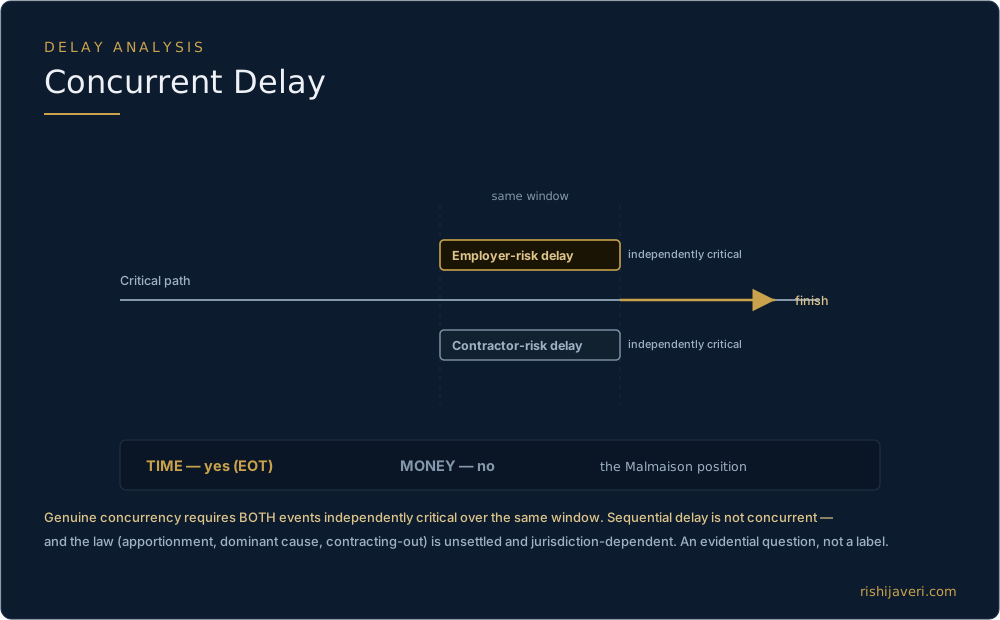
No concept in delay attracts more loose usage than concurrency. On site it means “two things went wrong at once.” In a claim it means something far narrower, and the gap between the two is where a great many positions quietly fail. True concurrency exists only where an Employer-risk event and a contractor-risk event each independently affect the completion date over the same period — each, on its own, would have delayed the works. Two problems overlapping in time are not concurrent unless both were genuinely driving completion; more often, only one was on the critical path and the other was noise.
Sequential delay dressed as concurrent
The first discipline is to test whether the concurrency is real at all. Analysts routinely present sequential delays — one following the other — as concurrent, because concurrency is the argument that rescues a contractor’s own slippage. It is worth being blunt about the incentive: labelling your own critical delay “concurrent” with an Employer event is the standard move to convert culpable delay into an extension. A competent reviewer’s first question is whether each event was independently critical in the same window, tested against the programme current at the time, not asserted after the fact.
Time usually yes, money usually no
Where concurrency is genuine, the widely followed position under English law — the so-called Malmaison approach — is that the contractor is entitled to an extension of time notwithstanding its own concurrent delay. The logic is that the Employer-risk event did delay completion, so the contractor should not pay liquidated damages for that period. Compensation is different. For prolongation cost the contractor generally recovers nothing for the concurrent period, because its own delay would have caused the same overrun regardless; the Employer should not pay for time the contractor would have lost anyway. Time yes, money no — the single most useful heuristic in the subject, and one that follows directly from who owns the delay.
Apportionment, dominant cause, and contracting out
Beyond that heuristic the law is genuinely unsettled, and honest practice acknowledges it. Some jurisdictions have entertained apportionment of concurrent delay between the parties — the Scottish courts more readily than the English, which have largely resisted splitting a single period. Others reach for a dominant cause analysis where one event can fairly be said to predominate. And parties increasingly contract out: an express concurrency clause allocating the risk of concurrent delay to the contractor has been upheld under English law, which means the starting question is always what this contract says before what the general law provides. None of these positions is universal, and importing an English authority into a UAE-governed contract without checking how the Civil Code treats concurrent causation is a mistake I have seen sophisticated parties make.
Proving it, or disproving it
Because so much turns on whether concurrency is genuine, it is ultimately an evidential question, not a rhetorical one. Was each event independently critical over the same window? The contemporaneous programme, the updates and the records answer that; the submission’s characterisation does not. A claim that leans on concurrency to explain away the contractor’s own delay rarely survives a reviewer who rebuilds the driving path window by window. The fuller treatment — the competing definitions, the apportionment authorities and the practical tests — sits in concurrent delay in construction.
This describes professional practice and is general in nature; it is not legal advice. The law on concurrency is unsettled and jurisdiction-dependent, and outcomes turn on the specific contract and governing law.
Related