Construction Claims
Basics of Construction Claims · Part 4 of 8
Who Owns the Delay?
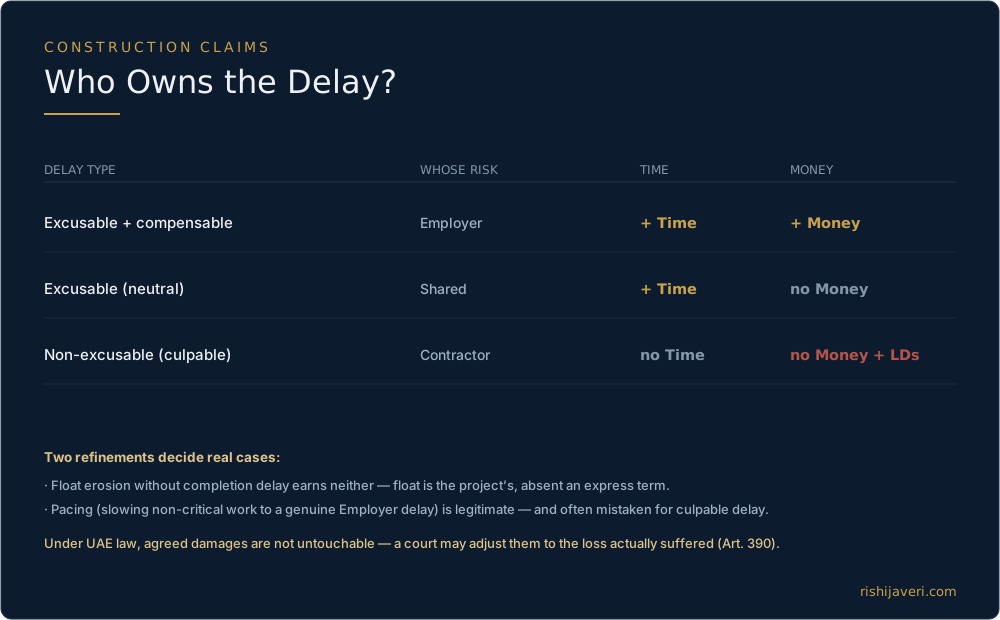
Once a delay to completion is established, the outcome turns entirely on risk allocation — whose risk was the delaying event under this contract, read against this governing law. Three categories carry most of the answer; the interesting cases live in the margins.
Establishing that an event delayed completion is only half the work. The half that decides the outcome is the allocation question: whose risk was that event under the contract, and what does the governing law do with the allocation the parties agreed. Get the delay analysis right and the risk allocation wrong, and you have a precise answer to the wrong question.
The three categories, and why the middle one matters
Excusable and compensable — the delaying event is the Employer’s risk: late access, late or defective information, a variation, an instruction, an act of prevention. The contractor is entitled to time and to the associated prolongation cost. The FIDIC forms enumerate these causes of extension; bespoke Employer conditions narrow them, and the drafting is where the risk actually sits.
Excusable but non-compensable (neutral) — the event is at neither party’s fault in a way the contract shares: certain adverse weather beyond defined thresholds, specified exceptional or force-majeure-type events. The contractor gets time — relief from liquidated damages — but each side carries its own cost. This is the category contractors most often misread, pricing prolongation into what the contract treats as a no-cost extension.
Non-excusable (culpable) — the event is the contractor’s own risk: its labour, its subcontractors, its productivity, its rework. No time, no money, and continued exposure to liquidated damages.
Float, pacing and the subtleties that decide real cases
Two refinements separate a competent allocation from a naïve one. The first is float ownership, addressed under Extension of Time: absent an express term, float is generally the project’s, so an Employer-risk event that merely erodes float without pushing completion creates neither time nor compensable cost. The second is pacing — where a contractor, faced with a genuine Employer delay on the driving path, reasonably slows non-critical work to match, rather than expending resource to run ahead of a project that cannot finish early. Pacing is a legitimate response, but it is frequently mistaken — by the contractor claiming it and the Employer resisting it — for culpable delay. Distinguishing a paced activity from a simply late one requires contemporaneous evidence of intent, not a retrospective label.
The prevention principle and time at large
Where the Employer prevents completion and the contract’s extension mechanism cannot operate to grant the time — because it was not invoked, or is inoperable, or a condition precedent has defeated it — the prevention principle can put time “at large” under common-law systems, reducing the completion obligation to a reasonable time and imperilling the right to liquidated damages. It is a powerful argument and an over-used one; it depends heavily on the contract and the jurisdiction, and it is not a general escape from a missed notice.
The UAE dimension
None of the common-law scaffolding transfers automatically to a UAE-governed contract. The Civil Code approaches causation and the apportionment of liability on its own terms, requires good-faith performance, and — importantly for delay — allows the court under Article 390 to adjust an agreed sum for damages to reflect the loss actually suffered, so a liquidated-damages figure is not the untouchable number parties often assume. On UAE programmes I treat the FIDIC allocation as the starting framework and the Civil Code as the law that ultimately governs how that allocation is enforced. Reading only the first leads confident analysts to wrong conclusions.
Where it leads
Real projects rarely deliver one clean, singly-owned delay. When an Employer-risk event and a contractor-risk event drive completion over the same period, the allocation question becomes the concurrency question — time usually yes, money usually no — which is the subject of concurrent delay, and which builds directly on these three categories. The full treatment sits under Extension of Time claims.
This describes professional practice and is general in nature; it is not legal advice. Risk allocation and the treatment of agreed damages depend on the specific contract and governing law.
Related