Construction Claims
Basics of Construction Claims · Part 2 of 8
Extension of Time — Beyond the Basics
An Extension of Time is widely misunderstood as a claim for money. It is not. Understanding precisely what an EOT secures — and what it deliberately leaves unresolved — separates a position that holds from one that unravels on review.
An Extension of Time does one thing precisely: it moves the contractual date for completion to a later date the contractor is entitled to. Everything else people load onto it — money, prolongation, disruption, headcount on standby — is a separate question that an EOT neither answers nor promises. Keeping that boundary crisp is, in my experience, the single clearest marker of whether the person preparing or assessing a claim actually understands it.
What the EOT secures, and what it deliberately does not
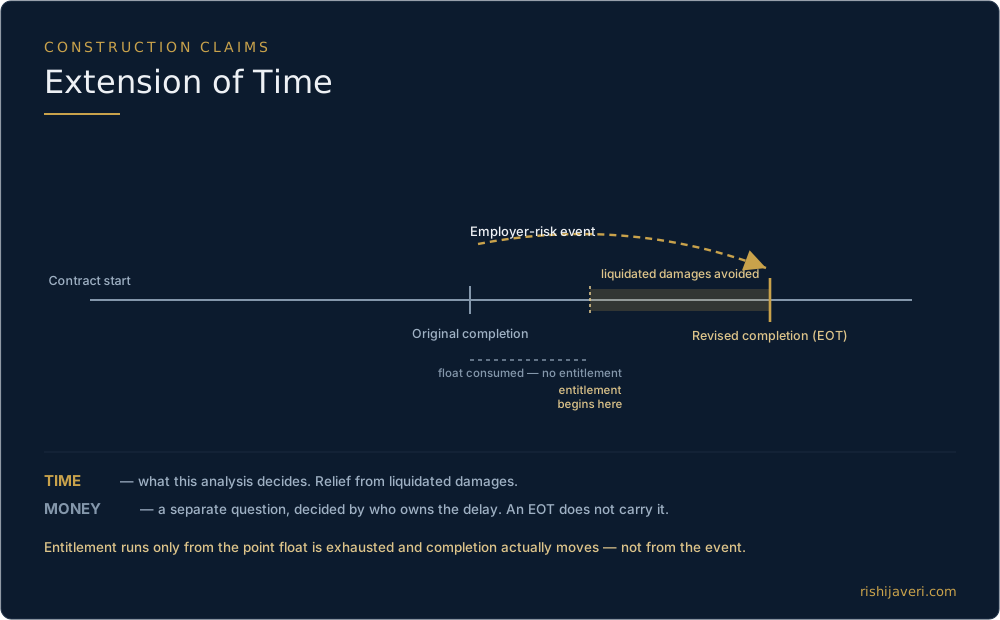
The immediate function of an EOT is protective. By resetting the completion date, it removes the contractor’s exposure to liquidated damages for the extended period and preserves the Employer’s right to levy damages for any further overrun beyond the revised date. What it does not do is entitle the contractor to a penny. Time relief and money are decided by different tests: time turns on effect to completion along the critical path; money turns on who bears the risk of the delaying event, which is the subject of who owns the delay. A delay can be fully excusable — earning time — while being non-compensable, earning nothing. Contractors who assume the two travel together tend to price prolongation into an EOT submission and hand the reviewer an easy reason to reject the whole thing.
Float ownership and the “who gets there first” problem
Because entitlement follows the critical path, and criticality is a function of float, EOT assessment is really an argument about float. If a relevant event consumes float that the contractor was relying on but did not own, is that a delay to completion? Generally not — float, absent an express allocation, is a project resource, and an event that merely erodes it without pushing the completion date creates no time entitlement. This is where many claims quietly inflate: an Employer-risk event is real, but it lands on a path with slack, and the days claimed are days of float consumed rather than completion delayed. A disciplined assessment isolates the moment float is genuinely exhausted and counts only from there.
Condition precedents: the claim can be right and still fail
Under the FIDIC forms and most bespoke Employer conditions, entitlement is gated by notice. The 2017 Red Book treats the notice under Sub-Clause 20.2.1 as a condition precedent: serve it late and the entitlement can be lost regardless of merit. I have seen technically sound EOT positions defeated not on the delay analysis but on a notice served weeks outside the window, or served to the wrong recipient, or framed as correspondence rather than a formal claim. Treating notices as administration rather than as part of the claim is a costly habit. The corollary matters too — in jurisdictions applying the prevention principle, an Employer act of prevention coupled with an inoperable extension mechanism can put time “at large,” and the completion obligation reduces to one of reasonable time. UAE contracts, governed by the Civil Code rather than English common law, approach causation and good faith differently again, which is precisely why the contract and the governing law have to be read before the programme is opened.
Prospective or retrospective — the assessment stance changes the number
An EOT can be assessed as at the time the event arose, on the programme then current and the information then known, or reconstructed later from the as-built record. The choice is not neutral: the same twenty-one events can yield materially different awards depending on the stance, which is why the prospective versus retrospective decision belongs at the front of the analysis, stated openly, not buried in the method. The SCL Protocol’s preference for assessing entitlement close to the event exists for a reason — contemporaneous assessment resists the hindsight that lets both sides re-engineer the past.
Where assessments go wrong
On the Riyadh City Infrastructure Programme in Abu Dhabi, the 291-day determination — twenty-one events, an Engineer’s assessment of sixty-seven days, an independent specialist’s sixty, my own of sixty-four approved — the distance between claim and award came down to three recurring faults: events pleaded as critical that sat in float; concurrency treated as if it did not exist; and cause-and-effect asserted rather than modelled through the programme current at the time. None of that is exotic. It is the ordinary discipline of counting only the days that move completion, and being able to show your working to someone determined to disagree. That is the standard set out in how EOT entitlement is assessed and applied across Extension of Time claims.
This describes professional project-controls and claims practice and is general in nature; it is not legal advice, and entitlement depends on the specific contract and governing law.
Related