Delay Analysis
Basics of Construction Claims · Part 8 of 8
Prospective vs Retrospective Delay Analysis
Two competent analysts, the same events, the same records, different awards — because they stood in different places to look. The choice between a prospective and a retrospective stance is one of the most consequential and least examined decisions in a delay claim.
The series closes on the decision that quietly governs all of it. Before any method is chosen, an analyst decides where to stand — whether to assess a delay looking forward from the moment it arose, on the programme and information then current, or looking backward from the completed as-built record. It sounds procedural. It is often outcome-determinative, and it deserves to be stated openly at the front of an analysis rather than smuggled in through the choice of method.
The two stances
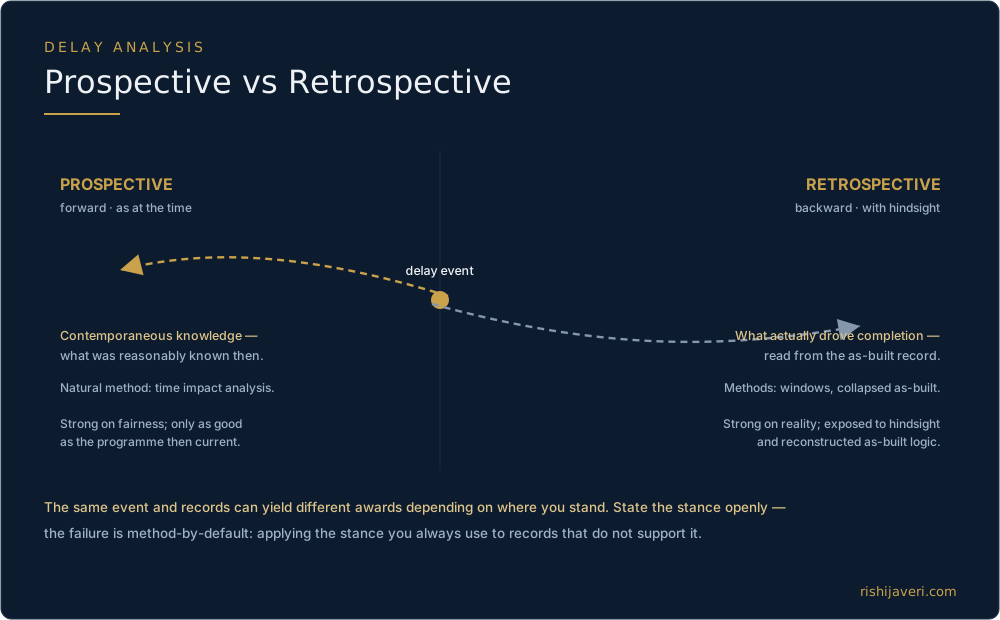
A prospective analysis judges an event as at the time it happened, using the programme reasonably current then and the knowledge then available — what a competent party would have concluded about the likely impact, before anyone knew how the works actually finished. Time impact analysis is its natural expression.
A retrospective analysis reconstructs from the as-built record what, with hindsight, actually drove completion. Windows and collapsed as-built methods live here. It asks not what was likely at the time, but what in fact occurred.
The two use different information by definition, so they can return different answers on identical facts. That is not a defect to be hidden; it is the nature of the exercise, and acknowledging it is a mark of integrity.
Why the choice moves the number
Prospective analysis captures contemporaneous knowledge — it resists the temptation, available to both sides after the fact, to re-engineer the past to suit the case. That is why the SCL Protocol favours assessing entitlement close to the event, and why contracts that require contemporaneous assessment are, in my view, better drafted. Its weakness is dependence on the programme then current: apply it to a poorly maintained baseline and you get a confident, worthless answer.
Retrospective analysis captures what actually happened — often more accurate, but exposed to hindsight, and to as-built logic that is frequently reconstructed and contestable. Its strength is reality; its risk is that reality, seen backward, can be curated.
Matching the stance to the situation
The choice is not free. A prospective stance fits where programmes were properly maintained and updated, where assessment is being made at or near the event, and where the contract calls for it. A retrospective stance fits where contemporaneous programmes were poor or absent, where the analysis is being done long after the fact in a dispute, and where the as-built record is the strongest available evidence. The failure I see most often is method-by-default — an analyst applying the stance they always use, to records that do not support it, and dressing the mismatch as methodology. A prospective method on a stale programme, or a retrospective analysis that cherry-picks the convenient as-built path, produces a number that will not survive a reviewer who understands the distinction.
The standard that survives
Whichever stance is chosen, the test is the same and it is unforgiving: could an independent analyst, given the same records, reach a comparable result. That reproducibility is what let a 291-day claim on the Riyadh City Infrastructure Programme resolve to an approved sixty-four days, and a 426-day position on the Hudayriyat West velodrome reduce to ninety-one — in each case the stance was chosen to fit the evidence, stated plainly, and every day traced from it. Master the vantage-point decision and the rest of delay analysis stops being a contest of methods and becomes what it should be: a disciplined reading of what the record can honestly support.
This describes professional practice and is general in nature; it is not legal advice, and the appropriate approach depends on the contract, the records and the governing law.
Related