Delay Analysis
Basics of Construction Claims · Part 7 of 8
How a Delay Is Measured
There is no single correct way to measure delay — there is a correct way for the records, the programme quality and the timing in front of you. Choosing the method, and being able to defend the choice, is most of the analysis.
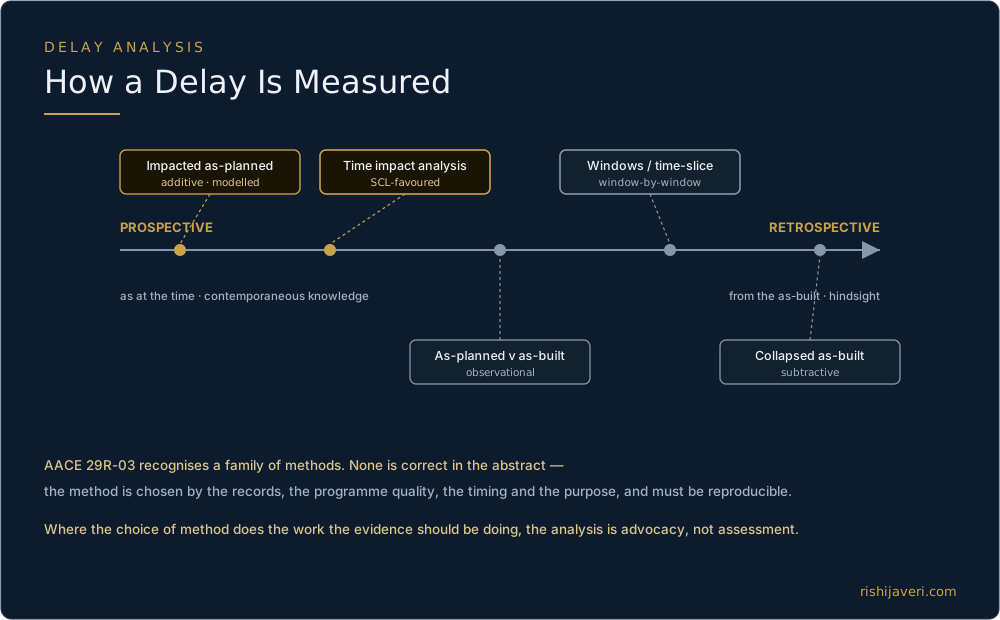
Measuring delay is not counting how many days an activity ran late. It is demonstrating, through the programme, how a specific event moved completion along the critical path — and there is a recognised family of methods for doing it, each with a proper application and a characteristic weakness. AACE International’s Recommended Practice 29R-03 classifies them along axes that are worth knowing because they force the two questions that matter: is the analysis observing the record or modelling an effect, and is it judged prospectively, as at the time, or retrospectively, with hindsight.
The five you actually meet
Impacted as-planned (additive, modelled). Delay fragnets representing Employer events are inserted into the as-planned baseline and the schedule re-calculated. It is simple and cheap, and its weakness is fatal in most disputes: it ignores as-built reality and the contractor’s own delays, so it tends to overstate. Useful early and prospectively; rarely persuasive as a final forensic method.
Time impact analysis (additive, modelled). A fragnet is inserted into the programme current and updated to the point the event arose, and the movement in completion read off. This is the SCL-favoured method for contemporaneous, prospective assessment because it reflects the information available at the time. Its integrity depends entirely on the quality of the updated programme it is applied to — the TIA guide covers the mechanics and the traps.
As-planned versus as-built (observational). Lay the intended sequence against what actually happened and identify where and when the works diverged. It is transparent and intuitive, but on its own it shows that delay occurred, not why or whose — causation has to be argued separately.
Windows, or time-slice (observational/modelled by period). The workhorse of retrospective analysis on any programme of size. The works are divided into windows, and the driving path and delay are assessed within each against the schedule then in force. It respects the fact that the critical path migrates, and it is the method I most often reach for on a large forensic exercise.
Collapsed as-built (subtractive, retrospective). Delay events are removed from the as-built programme to reveal what would have happened but for them. Powerful in principle; its weakness is that it depends on as-built logic, which is frequently reconstructed and contestable.
Method selection is the real skill
The methods are not interchangeable, and choosing between them is not a matter of preference. It is driven by four things: the quality and availability of the records and programmes; the timing of the analysis relative to the events; the purpose — a contemporaneous EOT assessment calls for a prospective method, a dispute years later for a robust retrospective one; and proportionality to what is at stake. A rigorous analyst states the method, justifies it against those factors, and — the real test — produces a result another analyst could reproduce from the same records. Where the choice of method is doing the work that the evidence should be doing, the analysis is advocacy, not assessment.
In practice
On the Hudayriyat West velodrome, a forensic review that reduced a 426-day extension position to 91 across fifteen delay events, the method was a windowed retrospective analysis for exactly the reasons above: the events spanned a long period, the critical path moved repeatedly, and only a window-by-window reconstruction of the driving path could separate the days that genuinely delayed completion from the days that did not. The reduction was not a negotiation; it was the difference the method exposed between a claimed position and what the programme and the record could carry. Whether that analysis is run forward or backward from the record is its own decision — the subject of prospective versus retrospective — and it rests, as all of this does, on a programme sound enough to be believed, which is the province of schedule assurance.
This describes professional practice and is general in nature; it is not legal advice, and referring to AACE 29R-03 or the SCL Protocol describes an approach rather than any endorsement.
Related