Delay Analysis
Basics of Construction Claims · Part 1 of 8
Critical Path Analysis for Construction Claims
Almost every delay dispute turns on the critical path — and almost every weak one rests on a critical path that was never interrogated. The distinction between the schedule's critical path and the project's driving path is where claims are won and lost.
Ask what the critical path is and most people can recite the textbook answer: the longest continuous chain of logically linked activities, zero total float, the sequence that sets completion. That definition is correct and almost useless in a dispute, because the number that comes out of the software is only as good as the network beneath it — and on the programmes I’ve reviewed, that network is usually where the argument really lies.
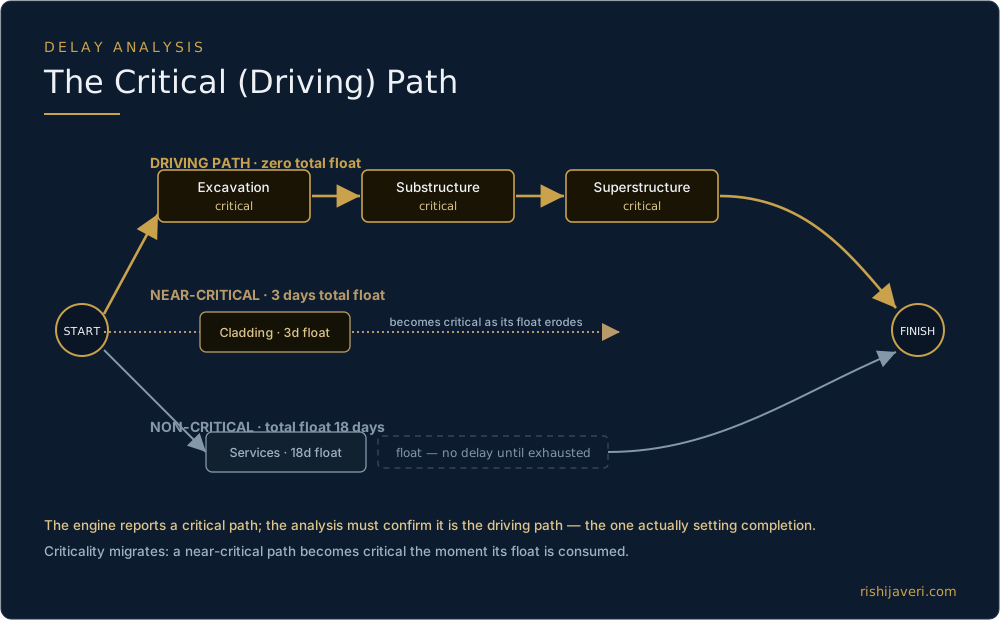
The critical path the software reports is not necessarily the one driving the project
The scheduling engine calculates a critical path from whatever logic, durations and constraints it is given. Feed it open ends, mandatory-start constraints, negative lags or a completion constraint holding the finish artificially, and it will still return a critical path — confidently, and often the wrong one. On Hudayriyat West, contractor programmes were arriving at roughly a quarter conformance against the schedule specification; a recurring cause was hard constraints and open-ended activities generating a critical path that ran through work no one on site regarded as driving. Automating the checks — a 100-point compliance engine applying DCMA principles across every P6 submission — lifted conformance past four-fifths, but the point for claims is narrower: a critical path you cannot trust cannot carry an entitlement. The first question in any analysis is not “what is critical” but “is this critical path real.”
Total float is the concept that actually does the work
Criticality is a consequence of float, not a property in its own right. An activity is critical because it has no total float; everything turns on how that float is calculated, and float is fragile. A single constraint can suppress it, a missing successor can inflate it, and a change in calendar can move it. Two practical consequences follow. First, float ownership matters: absent an express term, the general position is that float belongs to the project, not to either party to consume at will — which is why a contractor’s early works slipping into float is not, without more, a compensable event. Second, negative float is a signal to interrogate, not a finding to report: it usually means the network is being pulled against a constraint or an imposed date rather than telling you the works are genuinely late.
Longest path, driving path, near-critical
On a large programme there is rarely one critical path; there are several near-critical paths sitting within a few days of each other, and the “critical” one migrates as the works progress and as each update is imported. This is why a single as-planned critical path, run once and relied on for the life of a claim, is such a weak foundation — it captures a snapshot the project left behind months earlier. The more defensible unit of analysis is the longest path and the set of paths driving completion within each window of time, assessed against the programme that was actually current then. A delay event that lands on a path with fourteen days of float delays nothing until that float is exhausted; miss that and you have over-claimed by fourteen days before you have started.
Retained logic, progress override and the as-experienced path
How the software treats out-of-sequence progress — retained logic versus progress override — can change the critical path materially, and analysts on opposite sides routinely choose the setting that flatters their case without disclosing it. A rigorous analysis states the calculation mode and justifies it against how the work was actually sequenced. The deeper discipline is to reconcile the calculated critical path with the as-experienced one: the record of what site management were genuinely waiting on. Where the two diverge, the calculation is usually being distorted by logic that no longer reflects reality, and that divergence is the first thing a competent reviewer looks for.
Why this decides entitlement
Time entitlement follows the critical path, so if the critical path is wrong, the entitlement is wrong — not by argument, but arithmetically. In a determination I carried out on the Riyadh City Infrastructure Programme in Abu Dhabi, a contractor advanced 291 days across twenty-one delay events; the Engineer had assessed sixty-seven, an independent specialist sixty, and my assessment settled at sixty-four approved days. The gap between 291 and 64 was not a difference of opinion about the events. It was the difference between days that could be traced to the genuine driving path and days claimed against work that was sitting comfortably in float. Every one of the sixty-four survived because the path it sat on was validated first.
For how that driving-path movement is then measured, see how a delay is measured; for the wider discipline, construction delay analysis.
This describes professional project-controls practice and is general in nature; it is not legal advice, and positions on matters such as float ownership are contract- and jurisdiction-dependent.
Related