Construction Claims
Basics of Construction Claims · Part 3 of 8
Delay vs Disruption
Delay and disruption are used interchangeably on site and conflated in submissions — and that conflation is one of the most common reasons a genuine productivity loss recovers nothing. They are different effects, proven in entirely different ways.
Delay and disruption sit in the same sentence so often that they are treated as one idea. They are not, and the difference is not academic — it dictates the remedy, the evidence and the method. Delay is about the completion date. Disruption is about productivity. A project can suffer one without the other, and a submission that proves the wrong one recovers nothing.
Two different effects
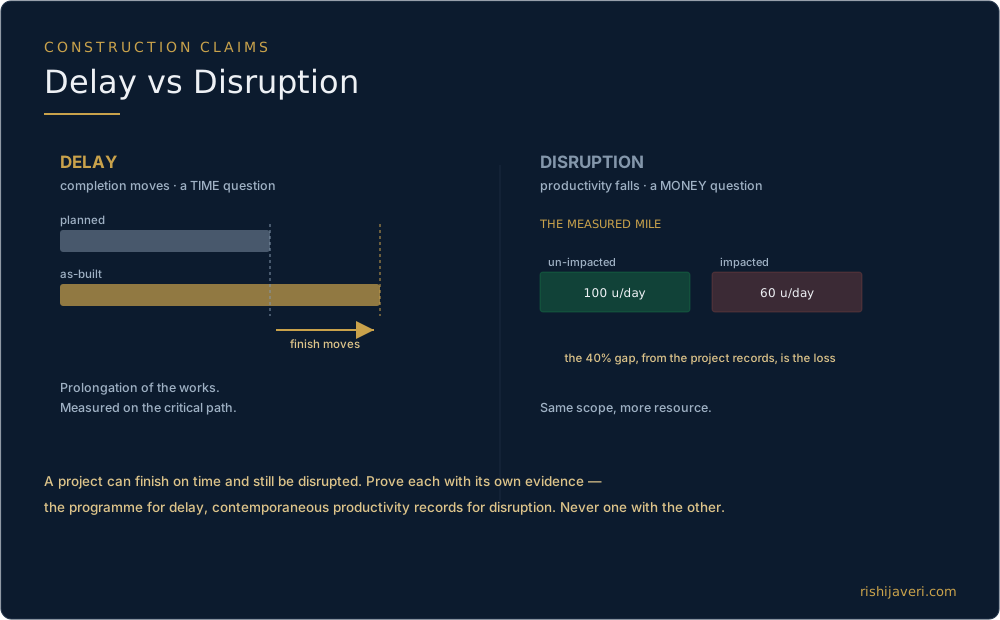
Delay is prolongation of the works to completion. It is measured against the critical path, resolved through an Extension of Time, and its cost — where the risk lies with the Employer — is time-related prolongation cost: the preliminaries and site overheads that run for longer because the site is open for longer.
Disruption is loss of productivity. Labour and plant achieve less per hour than they should have, because work is broken up, re-sequenced, congested, repeatedly re-mobilised, or overtaken by design change. The additional cost is not time-related; it is the extra resource consumed to deliver the same scope less efficiently. Critically, disruption can occur on a project that finishes exactly on time. The completion date never moved — but the work cost more to achieve.
Why disruption is the harder claim
Delay analysis has a spine: the programme and the critical path. Disruption has no equivalent, which is why it is so often lost. To prove it you must establish what productivity should have been, what it actually was, and that the shortfall was caused by matters at the Employer’s risk rather than by the contractor’s own inefficiency. Each limb is contested.
The most robust technique remains the measured mile: compare the productivity actually achieved during an un-impacted period on the works with productivity on comparable work during the impacted period, using the project’s own records. Because both figures come from the same job, the same crews and the same conditions, it neutralises arguments that the baseline was unrealistic. Where a clean un-impacted period does not exist, analysts fall back on earned-value comparisons of planned against achieved output, or — weaker, and treated with suspicion by tribunals — industry productivity studies and factor-based models. The further you move from the project’s own contemporaneous output records, the weaker the claim.
The global claim trap
The commonest failure I see is the global, or total-cost, claim: the contractor totals every hour and every dirham spent above the tender allowance, attributes the lot to a basket of Employer events, and invites the reviewer to accept the shortfall as disruption. It rarely survives. A global claim collapses the moment the respondent shows that some of the loss flowed from the contractor’s own causes — under-resourcing, rework, subcontractor failure — because the claim offers no way to sever those. The discipline that saves a disruption case is the unglamorous one: linking specific causes to specific losses on specific work, supported by the daily labour allocation records that most projects keep badly and need desperately.
What the framework says
The SCL Delay and Disruption Protocol treats disruption as distinct from delay and favours the measured mile precisely because it is grounded in the project’s own performance. That framing is useful, but the Protocol is guidance, not law, and its persuasive weight varies by jurisdiction — a point that matters more in the UAE, where the Civil Code’s approach to causation and to proof of loss governs rather than the common-law authorities the Protocol reflects.
The practical discipline
When something goes wrong on site, separate the two questions at the outset and keep them separate: did it move the completion date (delay, proven through the programme) and did it make the work less efficient (disruption, proven through productivity records). Answer them with different evidence, price them differently, and never let a disruption argument lean on a delay analysis or vice versa. That separation is, quietly, one of the surest signs of a claim built by someone who has done this before. It runs through the wider approach to construction claims.
This describes professional practice and is general in nature; it is not legal advice, and the treatment of disruption depends on the contract and the governing law.
Related