Construction Claims
Basics of Construction Claims · Part 6 of 8
Notices & Records
The analysis everyone finds interesting comes last. By the time it arrives, the outcome is usually already fixed by two unglamorous things done — or not done — at the time: the notice served, and the record kept.
Most claims that fail do not fail on the merits. They fail because a notice was late or a record was never kept — decided long before anyone opened the programme. The delay analysis that dominates the argument is, in truth, the last act; the outcome is usually set by the contract administration done in real time, which is exactly why that administration deserves the seriousness it rarely gets.
The notice as condition precedent
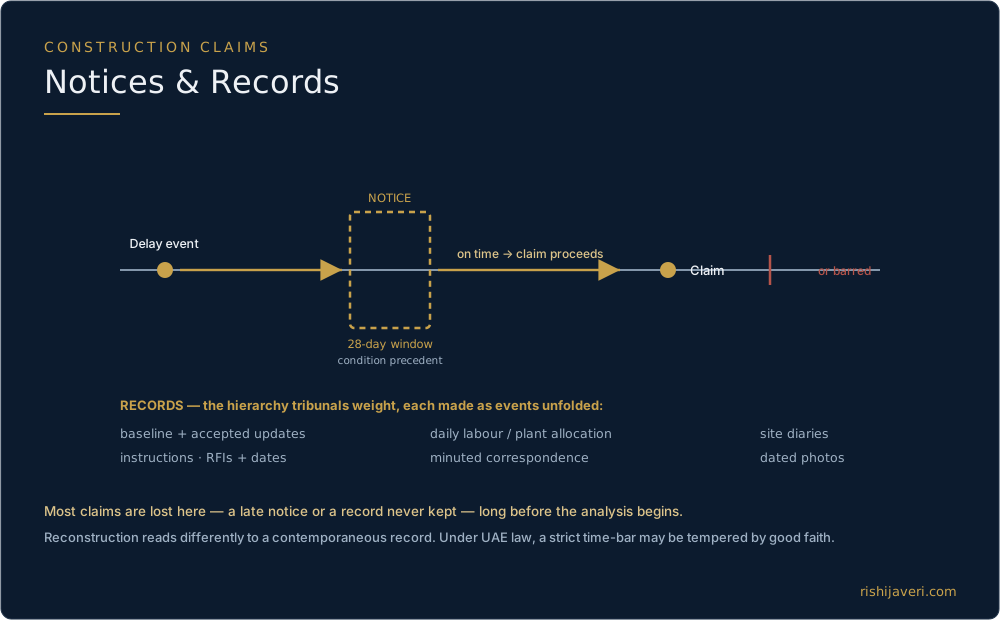
Under the 1999 FIDIC forms, the initial notice of a claim under Sub-Clause 20.1 must be given within 28 days of the contractor becoming aware, or having grounds to be aware, of the event — and it operates as a condition precedent: miss the window and the entitlement can be lost, however strong it would have been. A fully detailed claim then follows within a further 42 days. The trap is not ignorance of the clause; it is treating the notice as correspondence — an email that describes the problem without invoking the mechanism, sent to the wrong recipient, or dressed as a progress comment. I have watched sound entitlements defeated on precisely this, the delay analysis never reached because the gate closed first.
Time-bars are not, however, uniformly enforced. Their bite varies by jurisdiction, and under UAE law the good-faith obligation and the court’s supervisory role can temper a strict contractual bar in a way an English-law reading would not predict. That cuts both ways — a contractor should never rely on it, and an Employer should never assume a time-bar is automatically fatal to the other side. The governing law has to be read alongside the clause.
Records: the evidence you cannot manufacture later
A claim is only as strong as its contemporaneous record, and Sub-Clause 20.1 of the 1999 forms makes the point explicit — the contractor must keep the contemporary records needed to substantiate a claim, and the Engineer may monitor the record-keeping and instruct that further records be kept. What tribunals actually weight is a hierarchy: the baseline programme and its accepted updates; daily labour and plant allocation sheets; site diaries and progress records; instructions, RFIs and their response dates; correspondence and minuted meetings; and dated photography. The value of every one of these is that it was created as events unfolded. Reconstruction — the schedule and the narrative assembled at the end, for the claim — reads differently, and an experienced reviewer or tribunal can tell. On the Riyadh City Infrastructure Programme, the 291-day determination I assessed to sixty-four approved days, what carried the surviving days was not the elegance of the analysis; it was that each was anchored in a record made at the time, capable of being tested and reproduced.
Building the position in real time
The strongest claims are assembled quietly, while the work runs: notify within the window and in the right form; keep the programme current and properly statused; maintain the allocation records that disruption cases live or die on; and preserve the correspondence trail that fixes cause and date. Done consistently, this front-loaded discipline means that by the time the delay analysis is needed, the claim is already most of the way home. Neglected, no amount of later analysis rebuilds it. This is the substance behind what makes an EOT claim defensible.
This describes professional practice and is general in nature; it is not legal advice. The enforceability of notice provisions and time-bars depends on the specific contract and governing law.
Related